
That question stayed with me after visiting Carnegie Oldpark in North Belfast. The former library is being reimagined as a centre for weaving, learning and community use.
At first, turning a library into a weaving centre might seem like a change of purpose. In reality, it is a continuation. The building was created to place knowledge in the hands of working people. More than a century later, it may do exactly that again—only now, some of that knowledge will be carried in the hands themselves.
In the age of artificial intelligence, that feels increasingly important.
From books to looms
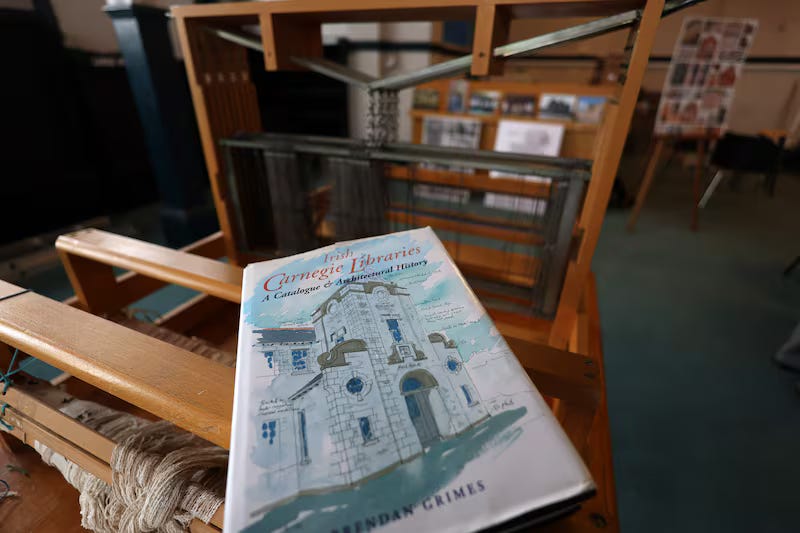
Oldpark Library opened in 1906 as one of three Belfast libraries funded by Andrew Carnegie. Alongside libraries on the Falls Road and Donegall Road, it was built within a working-class community where access to education and opportunity could not be taken for granted.
Carnegie called his libraries “palaces of learning”. Oldpark served North Belfast for more than a century before closing in 2010. It was later purchased at auction by Quintin Oliver and Fiona MacMillan, who wanted to prevent its loss and return it to community use.
During my visit, Quintin described the ambition to create a shared, cross-community centre for weaving, learning and participation.
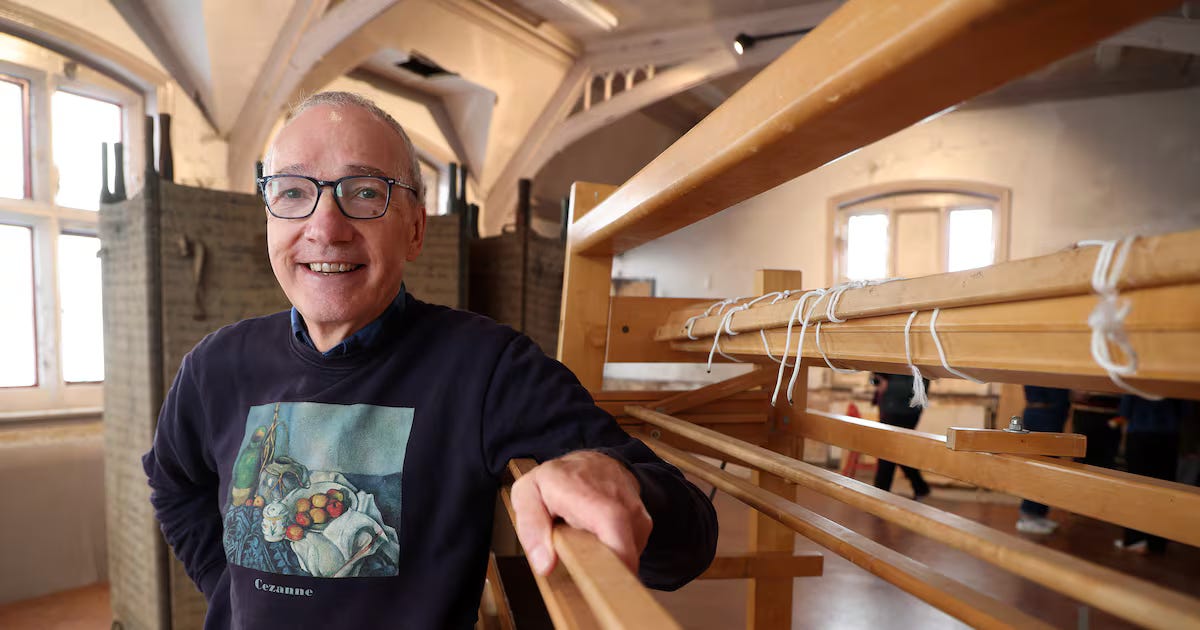
Weaving belongs here. Carnegie came from a family of handloom weavers in Scotland. His father lost his livelihood as industrialisation changed textile production, contributing to the family’s emigration to America. Carnegie himself began working in a textile mill as a child.
Weaving is equally rooted in Belfast. Linen connected the city’s mills and warehouses to flax-growing communities across Ulster. It linked rural and urban life, domestic knowledge and global trade, and generations of workers whose skills helped shape this place.
Bringing looms into Carnegie Oldpark reconnects these strands of history. The building once helped people understand the world through books. It can now help them understand material, process and place through making.
What does it mean to know something?
Artificial intelligence can retrieve, analyse and generate information almost instantly. I use it myself and recognise the opportunities it creates. But it also forces us to reconsider what knowledge actually means.
Is knowledge simply having access to the right answer?
A weaver does not only know the instructions for operating a loom. They feel tension through their fingertips, recognise when something sounds wrong and respond to small changes in the fibre. Their understanding has been formed through practice, repetition and experience.
AI can explain weaving and generate a pattern. It cannot experience the resistance of the loom, the rhythm of the process or the satisfaction of cloth gradually emerging beneath human hands.
As more intellectual tasks become automated, embodied knowledge may become more valuable, not less.
Craft is more than production
Craft is often judged by the object it produces. Yet making develops patience, attention and judgement. It teaches us that materials have limits, that mistakes cannot always be deleted and that worthwhile work often emerges slowly.
Craft also connects us to other people. A skill learned from someone else carries traces of everyone who practised and passed it on before us. We do not simply acquire a technique; we enter a continuing relationship with materials, people and place.
That matters in an increasingly digital world. We can now communicate across continents while barely knowing the person next door. We consume endless information through screens, yet often feel detached from our physical surroundings.
Craft brings the mind, body and material world into the same place. It can also bring people into the same room.
A loom behind glass tells us about history. A loom being used allows knowledge to travel between generations. This is the difference between preserving heritage and activating it.
A shared inheritance
One reason I am drawn to Irish linen is that it cannot be claimed exclusively by one community in Northern Ireland.
Its history crosses political, religious and geographical boundaries. It includes earlier Irish flax traditions, rural farming families, Huguenot knowledge, Quaker enterprise, Ulster-Scots industrialisation and generations of mill and factory workers, many of them women.
Nationalist and unionist communities both contributed to it. Rural and urban places depended upon one another. No single group owns the story.
That gives linen particular value in a society where heritage is so often presented as belonging to “us” or “them”. It offers a shared inheritance without erasing the different experiences within it.
A weaving centre at Carnegie Oldpark could therefore be more than the revival of a traditional craft. It could become a place where people meet through a history that is complex, interconnected and still evolving.
Keeping hold of what makes us human
Regeneration is often described as the arrival of something new: new buildings, investment or technology. Yet communities already possess assets, places, memories, relationships and skills. Carnegie Oldpark shows what can happen when those assets are recognised and connected.
The building provides the place. Its history provides meaning. Weaving provides a shared activity. The community will determine what happens next.
This is not nostalgia. It is inherited knowledge being put to work for the future.
AI will undoubtedly change how we learn, work and create. The answer is not to reject it or romanticise the past. The challenge is to decide what we are unwilling to lose.
We should not mistake speed for wisdom, information for understanding or automated production for human creativity. We still need places where knowledge is shared slowly, relationships develop face to face and people experience the dignity of creating something through their own skill.
A century ago, the radical act was to put books into the hands of working people. Today, perhaps it is equally radical to place tools, materials and inherited skills back into those hands.
Carnegie Oldpark once allowed people to read, learn and imagine a different future. Through weaving and community participation, it may help North Belfast create one.

By: Kerry Freud
“I work between field and factory, material and system. My background is in manufacturing; my practice is in craft. Through Irish Linen, I explore how heritage, place, and sustainability intersect, and what gets lost in between.”
Follow her on Substack at https://kerryfreud.substack.com/about
Leave a Reply